
IRS Form 2555 is the form US citizens and resident aliens living abroad attach to Form 1040 to claim the Foreign Earned Income Exclusion and the foreign housing exclusion or deduction.
For the 2026 tax year, it can exclude up to $132,900 of foreign earned income per person, but only if you file it with your return.
The Foreign Earned Income Exclusion is one of the most valuable tax benefits for Americans abroad. The IRS does not apply it automatically. You claim it by completing Form 2555 and attaching it to your federal return.
Form 2555 is also easy to get wrong. It has nine parts, two qualifying tests that cannot be mixed, and housing calculations that depend on where you live.
Key Takeaways: IRS Form 2555
-
Form 2555 calculates the Foreign Earned Income Exclusion and the foreign housing exclusion or deduction. It is attached to Form 1040 and is never filed on its own.
-
For the 2026 tax year, the maximum exclusion is $132,900 per qualifying person, and the standard housing expense limit is $39,870.
-
To qualify, you need a foreign tax home and must pass either the Physical Presence Test or the Bona Fide Residence Test. You complete Part II or Part III, never both.
-
Only earned income qualifies. Pensions, Social Security, interest, dividends, and capital gains cannot be excluded on Form 2555.
-
Married couples who both qualify each complete their own Form 2555, even on a joint return.
-
Once you claim the exclusion, it stays in effect until you revoke it. Revoking it blocks you from claiming it again for five tax years without IRS approval.
Form 2555 Filing Essentials for the 2026 Tax Year
| Item | Detail |
| Official name | Form 2555, Foreign Earned Income |
| Who files | US citizens and resident aliens with a foreign tax home who pass the Physical Presence Test or the Bona Fide Residence Test |
| Filed with | Form 1040 or 1040-SR, or Form 1040-X when claiming the exclusion on an amended return |
| Maximum exclusion | $132,900 per qualifying person for the 2026 tax year ($130,000 for the 2025 tax year) |
| Base housing amount | $58.26 per qualifying day, about $21,265 for a full year |
| Standard housing expense limit | $39,870 for a full year, higher in the high-cost locations listed in IRS Notice 2026-25 |
| Deadline | April 15, 2027 for the 2026 tax return, or June 15, 2027 with the automatic extension for taxpayers living abroad |
| Where the exclusion is reported | Form 2555, line 45 carries to Schedule 1 (Form 1040), line 8d as a negative amount |

Not Sure Form 2555 Is Your Best Option?
Universal Tax Professionals compares the Foreign Earned Income Exclusion with the Foreign Tax Credit for your situation and prepares Form 2555 only when it lowers your US tax.
What is Form 2555?
Form 2555, Foreign Earned Income, is the IRS form that calculates how much of your foreign earned income you can exclude from US tax. It covers three benefits:
- Foreign Earned Income Exclusion. Excludes up to $132,900 of wages or self-employment income earned abroad for the 2026 tax year.
- Foreign housing exclusion. Excludes employer-provided amounts that cover reasonable housing costs above a base amount.
- Foreign housing deduction. Lets self-employed taxpayers deduct qualifying housing costs above the base amount.
Form 2555 is not a separate return. You still report all of your foreign earned income on Form 1040, then subtract the exclusion through Schedule 1.
Form 2555 is the reporting side of the Foreign Earned Income Exclusion, so this article focuses on completing and filing the form. The shorter Form 2555-EZ was discontinued after the 2018 tax year. Every filer now uses the full Form 2555.
Who Should File Form 2555?
You can file Form 2555 if you meet all three of these conditions:
- You are a US citizen or a US resident alien, such as a green card holder.
- Your tax home is in a foreign country. Your tax home is your regular or main place of work. You cannot have a foreign tax home while your abode remains in the US.
- You pass either the Physical Presence Test, which requires 330 full days in foreign countries during any 12-month period, or the Bona Fide Residence Test, which requires residence abroad for an uninterrupted period that includes a full tax year.
Who Cannot Use Form 2555
- US government employees. Pay from the US government, including military and civilian federal pay, does not qualify. Private contractors working for the US government can still qualify.
- Taxpayers with only passive foreign income. Pensions, rental income, dividends, and interest are not earned income.
- Rotational workers who keep a US abode. Someone who works abroad on rotation and returns to a US family home during time off does not have a foreign tax home.
When Form 2555 May Not Be the Best Choice
Qualifying does not mean you should claim it. In countries with income tax rates higher than US rates, the Foreign Tax Credit often produces a better result and can create carryovers for future years.
Claiming the exclusion also disqualifies you from the refundable portion of the Child Tax Credit for expat families.
Comparing the FEIE vs. the Foreign Tax Credit before you file can change which form belongs on your return.

How to Fill Out Form 2555: Part by Part
Form 2555 has nine parts. Most filers complete Part I, either Part II or Part III, and Parts IV, V, VII, and VIII. Parts VI and IX apply only if you claim housing benefits. 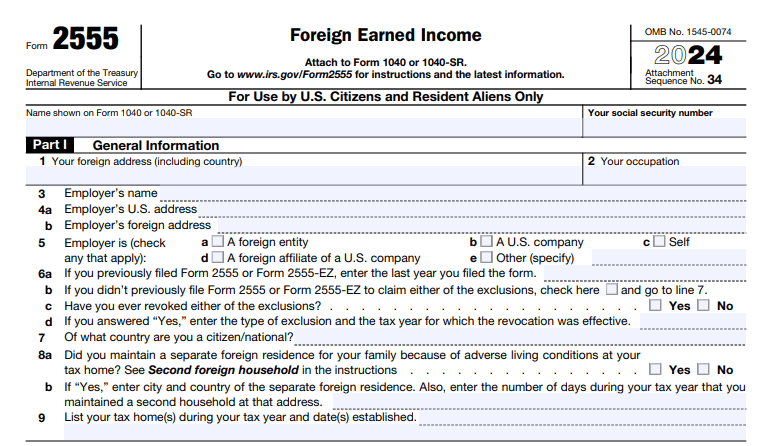 Source: IRS.gov
Part I: General Information
Part I covers your foreign address, your work, and your history with the form.
- Line 1: Your full foreign address, including the country.
- Lines 2 to 5: Your occupation, your employer’s name and address, and the type of employer, such as a foreign entity, a US company, or yourself.
- Line 6: The last year you filed Form 2555 and whether you ever revoked the exclusion.
- Line 7: Your country of citizenship.
- Line 8: Whether you kept a separate foreign home for your family because living conditions at your tax home were dangerous or adverse.
- Line 9: Your tax home and the date it was established.
Part II: Bona Fide Residence Test
Complete Part II only if you qualify under the Bona Fide Residence Test. You enter the dates your residence began and ended, or “Continues” if you still live abroad.
You also describe your housing, list family members who lived with you, and report days spent in the US during the year along with any income earned on those days.
Line 13 asks whether you told a foreign tax authority that you are not a resident of that country. If you did and they treat you as a nonresident, you cannot be a bona fide resident there.
This question catches people who claim nonresident status abroad to lower their foreign tax.
Part III: Physical Presence Test
Complete Part III only if you qualify under the Physical Presence Test. Line 16 asks for your 12-month qualifying period. Both dates must be filled in, and “Continues” is not accepted.
The table on line 18 lists each country you were in during that period, your arrival and departure dates, full days present, and any days and income from business travel to the US.
You complete Part II or Part III, never both. If you pass both tests, choose the one that gives you the longer qualifying period for the year, which matters most in the year you move abroad.
Part IV: Foreign Earned Income
Part IV totals the foreign earned income you received for work performed while you qualified. It includes:
- Wages, salaries, bonuses, and commissions (line 19)
- Self-employment and business income (line 20)
- Noncash income, such as employer-provided housing or a car (line 21)
- Allowances and reimbursements for cost of living, family, education, home leave, and housing (line 22)
- Other foreign earned income (line 23)
Pensions, Social Security, interest, dividends, capital gains, and alimony are not foreign earned income and never go in this part.
Pay for work you physically performed in the US is US-source income and stays out as well, even if a foreign employer paid it.
If you run a business where capital is a material income-producing factor, only a reasonable share of the profit counts as earned income, capped at 30% of net profit.
Line 25 lets you separately exclude meals and lodging your employer provided for its own convenience on its business premises.
Part V: All Taxpayers
Part V carries your total foreign earned income from line 26 to line 27. If you are claiming only the Foreign Earned Income Exclusion, skip Part VI and go to Part VII.
Part VI: Housing Exclusion and Housing Deduction
Line 28 totals your reasonable housing expenses for the qualifying period. Rent, utilities other than phone, property and renters insurance, nonrefundable lease fees, furniture rental, residential parking, and repairs all count.
Mortgage principal, mortgage interest, property taxes, buying furniture, domestic help, and pay TV do not. Your expenses are capped on line 29b. For the 2026 tax year, the limit is $39,870 for a full year in most locations, with higher limits for cities listed in IRS Notice 2026-25.
You then subtract the base housing amount of $58.26 per qualifying day. The result is your housing amount. Line 34 asks for employer-provided amounts, which include your salary.
Your housing exclusion equals your housing amount multiplied by the share of your foreign earned income that came from an employer. Self-employed filers with no employer-provided amounts enter zero on line 36 and use Part IX instead.
Married couples and residents of high-cost cities face additional foreign housing exclusion rules on this part of the form.
Part VII: Foreign Earned Income Exclusion
Line 37 is the maximum exclusion, $132,900 for the 2026 tax year. Lines 38 to 40 prorate it if your qualifying period covers only part of the year.
Line 41 subtracts any housing exclusion from your foreign earned income, and line 42 is the smaller of the two amounts.
Married couples who both qualify figure the exclusion separately, each on their own Form 2555. Community property laws do not change the amount.
Part VIII: Total Exclusion
Line 43 adds your housing exclusion and your Foreign Earned Income Exclusion.
Line 44 subtracts deductions that are definitely related to the excluded income, such as the excluded share of Schedule C business expenses.
Line 45 is your total exclusion, which you enter on Schedule 1 (Form 1040), line 8d as a negative amount.
Part IX: Housing Deduction
Part IX is for taxpayers whose housing amount is not covered by employer-provided amounts, which mostly means the self-employed.
The deduction is limited to foreign earned income that was not already excluded. Any unused amount carries over one year only, then expires.

Get Form 2555 Right the First Time
Universal Tax Professionals prepares Form 2555 as part of your complete expat return, from the qualifying test to the housing calculation, so your exclusion holds up if the IRS asks questions.
Form 2555 Example: Employee Living in Lisbon
Sarah is a US citizen who has lived and worked in Lisbon, Portugal, since 2023. For the 2026 tax year, she earns a $150,000 salary from a Portuguese company and pays $30,000 in rent and utilities.
She lived in Portugal all year and qualifies under the Bona Fide Residence Test.
| Line | Description | Amount |
| 27 | Total foreign earned income | $150,000 |
| 28 | Qualifying housing expenses | $30,000 |
| 29b | Housing expense limit | $39,870 |
| 32 | Base housing amount (365 days x $58.26) | $21,265 |
| 33 | Housing amount ($30,000 minus $21,265) | $8,735 |
| 35 | Share of income from employer | 1.000 |
| 36 | Housing exclusion | $8,735 |
| 41 | Foreign earned income minus housing exclusion | $141,265 |
| 42 | Foreign Earned Income Exclusion (smaller of $132,900 or line 41) | $132,900 |
| 45 | Total exclusion carried to Schedule 1, line 8d | $141,635 |
Sarah excludes $141,635, leaving $8,365 of her salary subject to US tax.
Under the FEIE stacking rule, that remaining income is taxed at the rates that would apply if the excluded income were still included, so it starts in a higher bracket.
She can still claim a Foreign Tax Credit for the Portuguese tax paid on the portion of her salary that is not excluded.
What Changes for Self-Employed Filers
If Sarah were a freelancer with the same $150,000 net profit, she would have no employer-provided amounts, so line 36 would be zero.
Her $8,735 housing amount would move to Part IX as a housing deduction, limited to the $17,100 of foreign earned income left after the $132,900 exclusion.
Self-employment tax would still apply to her full net profit, because the exclusion does not reduce self-employment tax.
This is one of the main reasons foreign self-employment income needs its own planning, including whether a totalization agreement applies.
How and When to File Form 2555
Attach Form 2555 to your Form 1040 or 1040-SR. Do not file it on its own. E-filing is the fastest option.
If you mail a paper return with Form 2555, send it to the IRS address designated for international filers, not the address for your former US state.
Form 2555 Deadlines for the 2026 Tax Year
- April 15, 2027: Regular due date for the 2026 tax return.
- June 15, 2027: Automatic two-month extension if you live and have your tax home outside the US and Puerto Rico on April 15. Attach a statement explaining that you qualify. Interest on unpaid tax still runs from April 15.
- October 15, 2027: Available by filing Form 4868 before the June 15 deadline.
Interest and penalties follow the same US expat tax deadlines that apply to the rest of your return.
If You Have Not Qualified Yet by the Deadline
In your first year abroad, you may not reach 330 days or a full tax year of residence before your return is due. You have two options:
- File Form 2350 before the regular due date to request an extension to a date after you expect to qualify.
- File on time without the exclusion, then claim it on an amended return using Form 1040-X once you qualify.
Claiming Form 2555 on a Late Return
The exclusion is normally chosen on a timely filed return, including extensions, or on an amended version of a timely return. Late returns can often still claim it, especially when you owe no US tax after the exclusion.
Americans catching up on several years of unfiled returns usually claim the exclusion through the Streamlined Filing Compliance Procedures.
Choosing and Revoking the Exclusion
Once you claim the exclusion, the choice stays in effect for later years until you revoke it. You do not need to revoke it in a year when you have no foreign earned income.
To revoke, attach a statement to the return for the first year you no longer want the exclusion. After revoking, you cannot claim it again for five tax years without IRS approval.
This matters if you move to a higher-tax country and want to switch to the Foreign Tax Credit. Claiming the exclusion also affects other parts of your return:
- Foreign Tax Credit: You cannot claim a credit for foreign taxes paid on income you excluded. You can still claim it on foreign income above the exclusion.
- Additional Child Tax Credit and Earned Income Credit: Neither is available when you claim the exclusion or the housing deduction.
- IRA contributions: Excluded income does not count as compensation when figuring how much you can contribute to an IRA.
- Tax on remaining income: You must use the Foreign Earned Income Tax Worksheet, which taxes non-excluded income at higher brackets.
Common Form 2555 Mistakes to Avoid
- Completing both Part II and Part III. Choose one qualifying test and complete only that part.
- Entering “Continues” for the Physical Presence Test. Line 16 requires two actual dates that cover a 12-month period.
- Excluding passive income. Pensions, dividends, interest, capital gains, and rental income cannot be excluded.
- Including pay for US workdays. Income for work performed while physically in the US is not foreign earned income.
- Filing one form for a married couple. Each qualifying spouse needs their own Form 2555.
- Claiming the Foreign Tax Credit on excluded income. You cannot take both benefits on the same income.
- Assuming the exclusion removes self-employment tax. Self-employment tax is figured before the exclusion and still applies.
- Skipping the return because income is under the limit. The exclusion only applies if you file, and US tax filing requirements for expats are based on gross income before the exclusion.
- Attaching a treaty disclosure you do not need. Claiming the exclusion does not require Form 8833, which is only for treaty-based return positions.

Claim the Foreign Earned Income Exclusion With Confidence
Universal Tax Professionals helps Americans in 150+ countries file Form 2555, choose between the exclusion and the Foreign Tax Credit, and stay compliant year after year.